National Laboratory of the Rockies, Energy Materials and Processing at Scale Facility
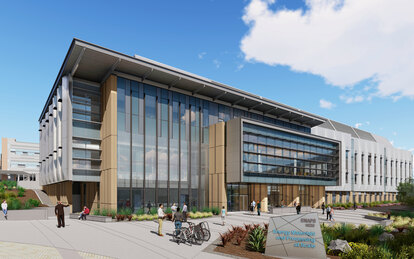
The National Laboratory of the Rockies (NLR)'s latest research facility integrates manufacturing processes at scale and maximizes collaboration, with a mission to accelerate the commercial adoption of new energy technologies.
Client
National Laboratory of the Rockies
Location
Golden, Colorado
Markets/Services
Science & Technology, Lab Planning, Architecture, MEP Engineering, Interiors, Landscape Architecture, Lighting Design
The National Laboratory of the Rockies (NLR) is the U.S. Department of Energy’s primary national laboratory for energy systems research and development. The DOE and NLR were in need of a new research facility to devise innovative ways that the U.S. can scale up the materials and processes needed to adopt emerging energy technologies.
In a design/build partnership with JE Dunn, SmithGroup designed the Energy Materials and Processing at Scale (EMAPS) facility, located on campus adjacent to the Energy Systems Integration Facility, another project SmithGroup and JE Dunn delivered together with NLR in 2014.
Advancing Energy Research Through Integrated, Open‑Lab Design
The EMAPS facility enables collaboration and rapid experimentation in an open lab setting among researchers, engineers and industry partners. Its goal is to develop innovations in energy materials and processes at scale, so they can be more quickly brought to market and implemented. The EMAPS facility itself excels as a model of energy performance, leveraging advanced energy strategies and systems that raise the bar for the built environment.
EMAPS features a straightforward zoned layout that brings together the multiple research disciplines of biology, chemistry, materials science, bio‑chemical analysis and process engineering. Six laboratory sections are grouped on three floors. The sloping site provides outdoor yard access to the high bay laboratories at level two. A public corridor connects the labs with research workstations and collaborative areas along the length of the building, allowing researchers to move freely from testing areas to discussion areas to computer desktops. Creating this continuum of connectivity was a key driver of the design, critical for the building to function as an incubator for the development of new techniques and processes.
The EMAPS laboratories provide specialized yet adaptable spaces to study the full life cycles and supply chains for energy‑related products and technologies, such as energy storage and technologies for grid modernization. EMAPS primarily supports research in electrons‑to‑molecules, advanced electrification, process innovation, and advanced biology and chemical processing. To ensure flexibility for future experimentation, the modular layout and plug‑and‑play system design allows for rapid reconfiguration and repurposing of spaces.
Designing for Efficiency in a High‑Desert Environment
The high‑performance building is a physical manifestation of NLR’s mission to advance building technologies, including reclaimed grey water, a highly efficient building envelope, judicious solar orientation and glare control, daylighting and site preservation. Located in the high desert of Golden, Colorado, the dedicated outside air systems leverage high‑performance heat recovery together with direct evaporative cooling. An extensive process cooling system (with over 2 MW of waste heat) is recovered to become the foundation for the building heating systems in this predominantly heating environment.
The facility is also designed to accept up to 3 MW of data center waste heat in the future from the Energy Systems Integration Facility (ESIF), which is located adjacent to the building. The integration of this waste heat strategy will further improve the energy efficiency of both buildings, reduce water consumption, and lead to an overall power reduction to the campus. These and other innovations allow the building to achieve a projected 50% energy cost reduction when compared to a minimally compliant all‑electric baseline building, targeting LEED Gold certification.