Post-Occupancy Engagement is Key to a Strong Workplace Strategy
Organizations are dynamic ecosystems, yet many companies are hesitant to adapt their workspaces as occupancy patterns, intended usage and employee expectations evolve. The following case study illustrates how one company is using ongoing post-occupancy engagement to create a continuous learning loop that benefits the organization and employees alike.
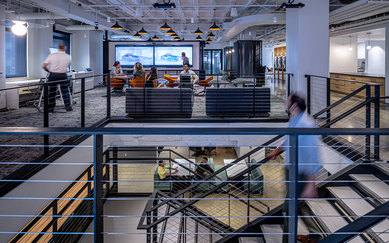
Organizations are dynamic ecosystems—a mix of diverse people, varied tasks and rapidly evolving technological and cultural contexts. Yet many organizations are hesitant to adapt their workspaces as occupancy patterns, intended usage and employee expectations evolve once construction is complete.
Post-occupancy engagement (POE) closes this gap. It offers a critical opportunity to investigate unfolding occupant experiences, generate actionable insights, and co-create meaningful solutions that help to adapt and inform future workplace strategies. The following case study illustrates how one company is using ongoing post-occupancy engagement to create a continuous learning loop that benefits the organization and employees alike.
Continuous Measures Integrated with Strategy
When the organization transitioned from a traditional office to an activity-based workplace (ABW) in 2019, repeated occupant engagement became the foundation of its strategy. At the onset of the project, the design team distributed a pre-occupancy survey developed by the UC Berkeley Center for the Built Environment (CBE) to collect feedback from employees regarding daily activities, job responsibilities, workstyle preferences and much more. This input helped to inform planning and design decisions at the project’s start and established a baseline data set for future analytic needs. The organization has deployed the same survey on an annual basis since construction completed. This allows the design and management team to continue to measure the performance success of the design, ensure that space typologies remain aligned with occupant needs, and gain insights into evolving expectations and behavioral patterns.
During a five-year span, the organization transitioned from a fully remote work model to a flexible hybrid approach and currently maintains a structured hybrid environment with employees spending three core days in the office. Even amidst change, survey response rates have remained consistently high (over 70%), and qualitative feedback from staff continues to provide insight regarding changing day-to-day office experiences. Overall, data shows that the company’s ABW model continues to meet most staff needs, and the ability to support individual and team work and overall office design remains high.
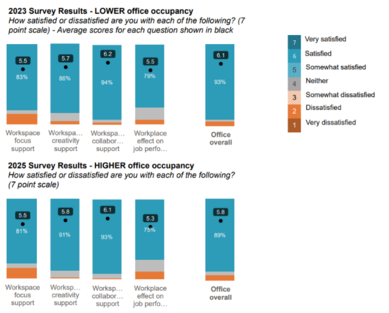
This yearly rhythm of dialogue, reflection and adjustment has become a cultural norm for this organization and is reinforced by roundtable sessions that further explore actionable changes and position engagement as invaluable to ongoing adaptation and improvement.
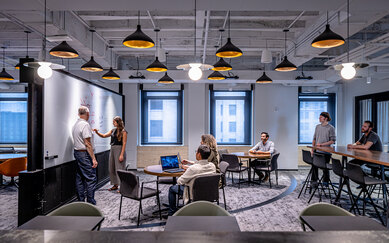
Turning Data to Actionable Insights
Data is the backbone of an effective post-occupancy feedback loop, turning assumptions into actionable insights. When combined with qualitative feedback, POEs can reveal insights that lead to precise solutions.
For instance, visual and acoustic privacy has remained a persistent employee concern since the example organization referenced herein initially transitioned to an activity-based workplace – a common challenge in open-plan environments. Here, the open area was intentionally designed to create “buzz” within spaces intended for individual and side-by-side work, with a separate (but nearby) quiet zone provided for tasks requiring hyper focus.
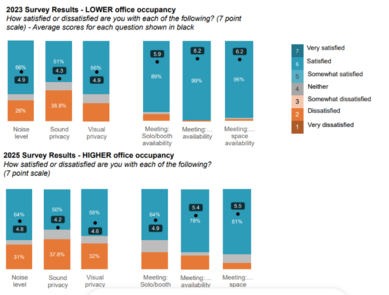
Some organizations would have immediately attempted to solve the issue by adding acoustic panels or piping in white noise without giving the “fix” much thought. But investigation and feedback from employees revealed that the issue was, in fact, not related to the physical office. The true issue was that the company’s workforce had evolved; nearly half the staff was new and unaware of how various zones across the office functioned or the range of space options that were available. The appropriate solution did not require physical modifications to the space. Instead, the onboarding process for new hires was modified to include guided tours explaining each work zone’s purpose and choices. This experience revealed a critical lesson: Strategy is most impactful when it is paired with education and engagement.
Other insights have driven physical changes within the office. Having experienced higher rates of occupancy in recent months, staff highlighted frustration with limited small meeting spaces accommodating 1-3 people. In response, several offices and ancillary spaces have since been converted into meeting rooms. In parallel, a sister office reevaluated and adjusted the placement of stand-alone phone booths after feedback revealed that placement and transparency are top concerns for staff – employees wanted to stay connected and visible to teammates while using these spaces. Insights such as this reflect evolving employee preferences and is helping to shape and guide the integration of new design features.
Making the Intangible Count
Not all insights are quantitative. Often, testimonials can reveal what hard numbers miss, as illustrated by the following excerpts provided by employees in recent surveys.
“Flexibility in the office is key and is much appreciated for having been a guiding factor in the renovation.”
“I like being able to see outside. I don’t sit in the exact same seat all the time – sometimes near windows, sometimes farther away, but natural light fills the space.”
Measuring true success often requires analysts to pair quantitative data with “squishier” hard to measure qualities like culture, vibrancy and movement. The strategy for this multi-floor office renovation prioritized human connection over convenience, adding a new open staircase adjacent to a centralized kitchen and coffee area. This has created a lively hub animated by shared lunches and spontaneous interactions and encourages movement far more than an array of dispersed amenities would. This solution has not only fostered a culture of connection, but also delivered measurable benefits, like increased daily steps. The company reports that even as hybrid work has reshaped routines, this space has remained resilient — humming with energy on core days and flexing as a calm refuge during quieter times, all while sparking serendipitous encounters.

From Static Spaces to Living Systems
In a world where employees can choose where they work, modern workplaces must go beyond surface-level perks to create environments that people genuinely want to inhabit. Ongoing engagement through repeated inquiry reframes success from “Did we get this right?” to “Does the space continue to foster connection, productivity and well-being?”
As technology and culture continue to reshape work, continuous feedback will be vital to an organization’s growth and success—ensuring that design intent and real user experiences align and turn traditional, static offices into adaptive ecosystems that evolve with employee and company goals.
The Future Awaits
The future of work isn’t static; it continues to evolve and adapt over time. The same principles should apply to the workplace. As market conditions, business models and employee needs change, companies that value and invest in ongoing engagement and adaptation as a key workplace strategy will be able to pivot faster than those that consider post-occupancy feedback uninformative and inconsequential. Is your organization — and your office — prepared to flex when the next wave of change arrives?