Designing for Social Connection in Longevity Living®
In 2023, we raised an important question in this same forum: can design help solve for loneliness in senior living? This piece returns to that question with evidence that it can.
At The Current South Shore, a senior living community operated by Monarch Communities in Boston, we set out to design a space that supports the mental, physical, and social wellbeing of residents, staff, and families. In June 2025, with the community nearing full occupancy, we went back to study whether it was working—to learn directly from the lived experience of the people living, visiting and working there.
Across every dimension of wellbeing we evaluated, social connection stood apart. The findings offer compelling evidence that thoughtful design can play a meaningful role in addressing loneliness in senior living.
Study findings showed that the integration between Independent and Assisted Living, the quality of light and aesthetics, the spectrum of shared social spaces and the support of direct human contact are transformative in shaping the lives of the residents, staff, and their families.
Longevity Living® is about designing for what people can do, not what they can't—creating environments that support independence, connection, and a genuine sense of purpose across every stage of life. The measure of whether that is working is not in the building. It is in what residents tell you about how they feel, how they connect, and how they spend their days.
Joyce Polhamus
Vice President, Senior Housing Market Leader
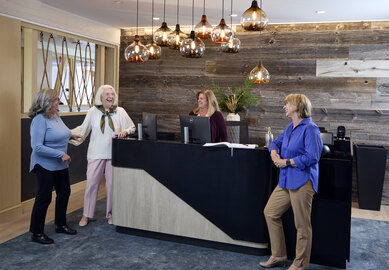
Photo Credit: Nigel Barker
CAPTURING OCCUPANT EXPERIENCE
The study was organized around eight dimensions of wellbeing capturing different design intentions—from a central gym with a dedicated physical trainer supporting resident health, to an accessible courtyard and floor-to-ceiling windows enabling year-round connection to nature. We launched the study with a site visit including a walkthrough with the design team and community leadership, structured conversations with hospitality and caregiver staff, and direct engagement with residents.
We followed the initial visit with a survey distributed across residents, families, and staff and returned throughout the summer to support participation. We came back a final time in September to share findings and discuss their implications.
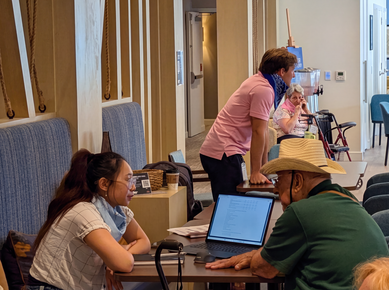
SmithGroup staff visiting over the summer to assist residents with the survey.
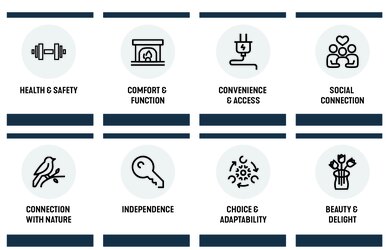
A central goal of The Current South Shore was to enhance the mental, physical, and social wellbeing of its residents, caregivers, and their families. In this post occupancy study, we evaluated eight dimensions of wellbeing.
SOCIAL CONNECTION EMERGES AS THE STRONGEST WELLBEING INDICATOR
Across the eight wellbeing dimensions, one stood apart. Seventy-six percent of all feedback referenced social connection, and ninety-four percent of those responses were positive. When we asked residents how much a strong sense of community mattered in their decision to move in, nearly all called it essential. Many said that community—not care level, location, or amenities—was what finally motivated them to leave a home they had lived in for decades and move into The Current.
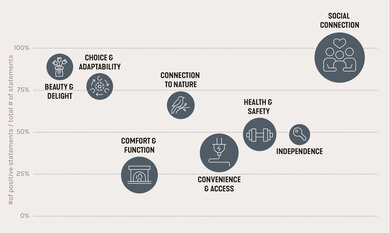
Statements from residents, caregivers, families, and leadership organized relative to dimensions of wellbeing and sentiment (positive, negative, neutral).
This chart illustrates the total number of statements (bubble size) and percent positivity (y-axis).
Research consistently shows that strong social relationships are among the most powerful predictors of health and longevity. For older adults in particular, meaningful relationships support emotional resilience, cognitive health, and a sustained sense of purpose.
Four design strategies emerged as central to making social connection possible.
1. Reducing Stigma Through Care Integration
A defining feature of the community is the seamless integration of Independent Living, Assisted Living, and Memory Care. Rather than separating levels of care, the design intentionally connects them—visually, spatially, and socially—with consistent aesthetics and shared amenities throughout. As one resident put it, "you don't know who is in which kind of care."
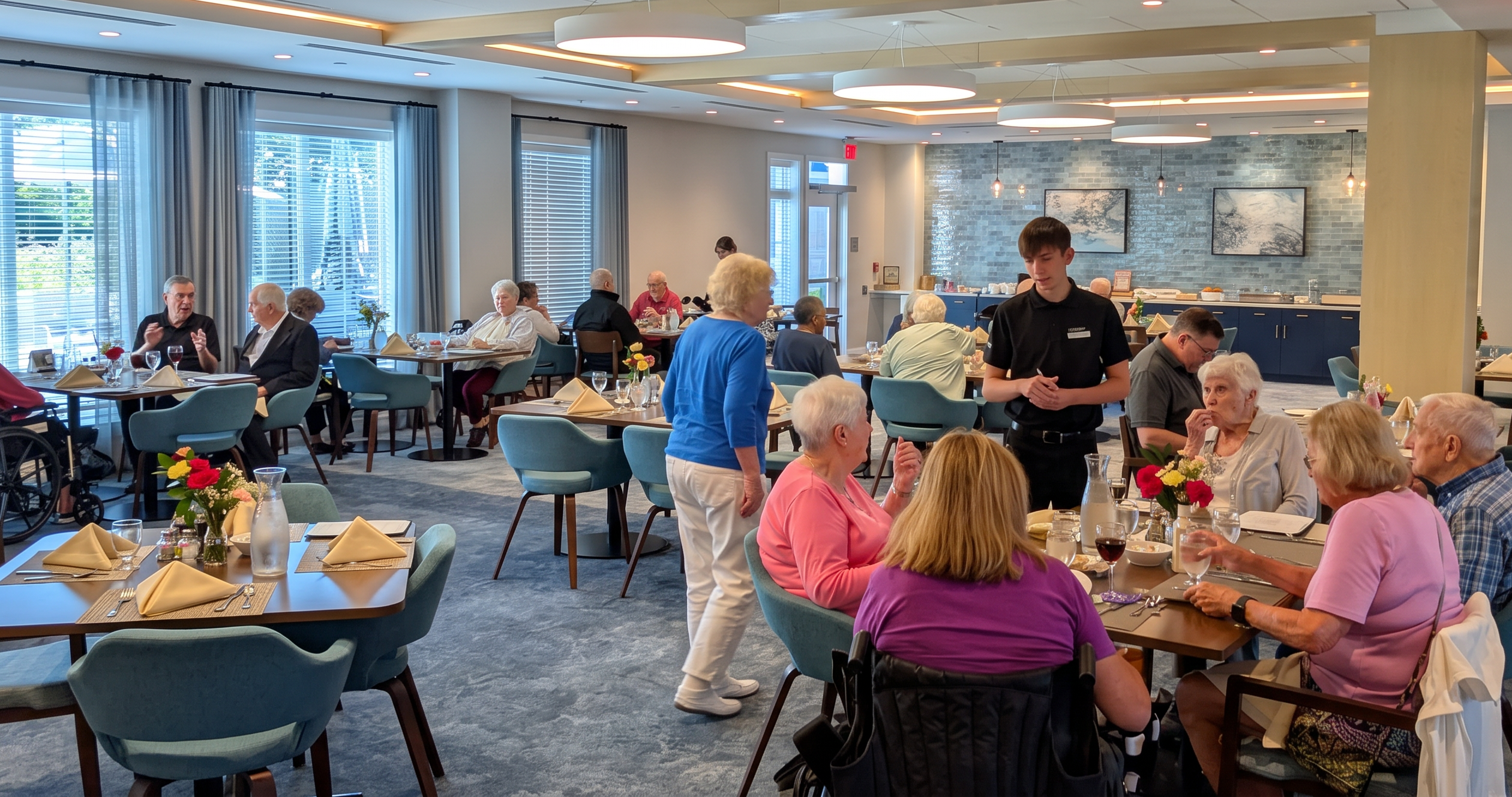
The impact on wellbeing is powerful. We learned about friendships that persist after changes in care needs, family members living across different levels of care who share meals and activities, and Independent Living residents volunteering in Memory Care, strengthening bonds across the community. Research suggests this approach also reduces stigma. When higher levels of care are visibly segregated, they can reinforce fear and social distance. By contrast, integrated environments can normalize care transitions and support continued participation in community life.
2. A Spectrum of Spaces
The challenge in senior living is designing environments where participation feels natural, where relationships can form without being engineered.
Designing for prospect and refuge is key. It recognizes our natural desire to feel secure while engaged. However, the level of comfort can change day to day, and enabling autonomy over one's environment is essential to sustained engagement.
Bonita Cook
Architect
At The Current, that principle shaped a deliberate spectrum of spaces. As Marlene Buckley Krukiel, the community's Life Enrichment Director, puts it, residents can "choose as much or as little engagement as they desire."
On Friday evenings, the central bar fills for Singo—a song recognition version of bingo—with the open stairs drawing residents toward activity. Meanwhile, on the fifth floor, the Horizon Room offers soft seating and expansive views for those who want a quiet respite. Designing equally for introverts and extroverts lowers barriers for those most vulnerable to isolation. We heard that over time, the opportunity for small choices has led to greater involvement.
3. A Building Worth Showing Off
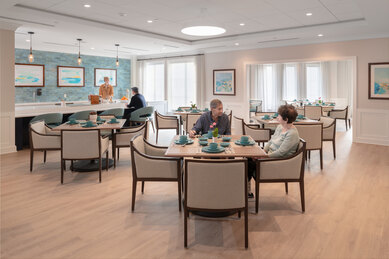
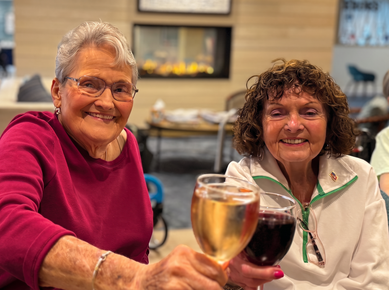
Residents described The Current as beautiful, joyful, and light-filled. We learned how abundant natural light, thoughtful material choices, and a cohesive aesthetic makes residents excited to invite others in. We heard from residents how proud they were to share their home with families and friends—inviting them to work out together or share a drink at the bar. And we heard from families and staff how the cheerful rooms and sophisticated décor elevate their own sense of comfort in the place.
Research shows that visitation frequency is strongly correlated with resident health outcomes, and the same qualities that make a community worth visiting strengthen referrals and support leasing.
4. Visibility, Proximity and Flexibility Facilitate Direct Interactions
The Current has developed an organic culture of mutual support. Neighbors routinely look out for one another – inviting newcomers for dinner, walking a friend's dog while they're ill, or carrying up their mail. Residents also describe a place where staff know their names. During our conversations residents described the staff as "the best thing here." In an industry defined by high turnover, that kind of loyalty stands out as a striking performance outcome.
Here again, design plays a quiet but critical role in reinforcing social connections. A central, visible lobby and 24-hour concierge encourage lingering and casual encounters. Outdoor seating frame views of arrival and departure, turning everyday movement into opportunity. Flexible dining layouts support larger group gatherings. Each spatial decision creates visibility, proximity, and natural gathering to help make this culture possible at scale.
WHAT'S NEXT?
An Occupancy Experience study is a partnership between clients, designers, and the residents. A set of actionable insights, oriented towards each partner, present meaningful next steps.
1. For The Current South Shore. The same study that documented the community's social strengths also surfaced specific areas for improvement — from shower details to training staff on serveries — findings that were brought directly back into conversation are now supporting operations and programming.
2. For Monarch Communities. Feedback on integration of care levels helps reinforce a working model, while input on limitations of the open office layout shape future design choices.
3. For Longevity Living®. These findings now inform our approach to intergenerational communities, models designed for the middle market, and environments where technology supports connection rather than replacing it.
4. For Research Operations. The evidence is still accumulating. As we keep conducting occupant experience studies we are building up our design performance database – quantifying the impact of our work while advancing design thinking. These studies support data-driven insights, but they are rooted in authentic engagement that centers on the human experience.
The Current South Shore Post Occupancy Study was conducted by Bonita Cook, Denge Agola, Leigh Snow, Alison Faescher, and Michal Russo. Study details can be found at: POE-Monarch.
REFERENCES
Relationship between specific leisure activities and successful aging among older adults. (2023). Journal of Exercise Science & Fitness, 21(1), 111-118. Retrieved from https://www.sciencedirect.com/science/article/pii/S1728869X2200079X.
Lam, K. (2025, August 4). Residential care increases social participation but gaps remain. University of Colorado Anschutz Medical Campus. Retrieved from https://news.cuanschutz.edu/news-stories/residential-care-increases-social-participation-but-gaps-remain.
Dobbs, D., Eckert, J. K., Rubinstein, B., Keimig, L., Clark, L., Frankowski, A. C., Zimmerman, S., & Morgan, L. A. (2016). Promoting and protecting against stigma in assisted living and nursing homes. The Gerontologist, 56(3). Retrieved from https://pmc.ncbi.nlm.nih.gov/articles/PMC4873761/.
Supportive Care. (2025, August 8). How to address mental health stigma in senior housing communities. Retrieved from https://www.thesupportivecare.com/blog/how-to-address-mental-health-stigma-in-senior-housing-communities.
Bower, M., Kent, J., & Patulny, R. (2023). The impact of the built environment on loneliness: A systematic review and narrative synthesis. Health & Place, 79, 102962. Retrieved from https://www.sciencedirect.com/science/article/abs/pii/S1353829222002234.
Gripko, M., & Joseph, A. (2024). The role of the built environment in supporting older adults' engagement: A narrative literature review. HERD: Health Environments Research & Design Journal. https://doi.org/10.1177/19375867241250320
Parker, C., Barnes, S., McKee, K., Morgan, K., Torrington, J., & Tregenza, P. (2004). Quality of life and building design in residential and nursing homes for older people. Ageing & Society, 24(6), 941-962. https://doi.org/10.1017/S0144686X04002387
Wang, C., Pan, Y., Li, X., & Qiang, S. (2025). A mixed-methods investigation for effects of built environments on older people's social interaction in care homes. Frontiers in Public Health, 13. https://doi.org/10.3389/fpubh.2025.1693935
Palmgren, M., Rosenberg, L., Gaber, S. N., & Johansson, K. (2023). Family members' reasoning in relation to pleasant environments in nursing homes. Dementia, 22(1), 235-251. https://doi.org/10.1177/14713012221142474