Grove City College, Smith Hall of Science & Technology
A college’s landmark is thoughtfully restored and expanded, preserving its historical character while transforming it into a modern STEM hub for a new era of learning and research.
Client
Grove City College
Location
Grove City, Pennsylvania
Markets/Services
Academic Research, Architecture, Building Enclosure Consulting, Higher Education, Lab Planning, Science & Technology, STEM (Science, Technology, Engineering, Math)
Size
61,600 SF
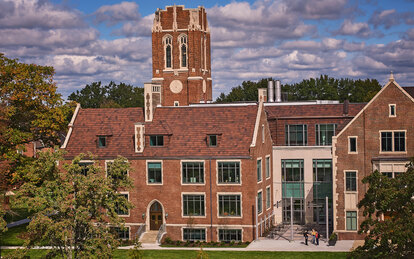
The red brick and soaring clocktower of what was originally the Hall of Science has been an enduring symbol for Grove City College since its construction in 1931, representing the Christian institution’s commitment to integrating faith and learning. Although beloved as a landmark, the aging building—renamed Rockwell Hall in the 1960s—needed substantial upgrades to remain relevant for contemporary learning and research. A campus master plan prepared by SmithGroup in 2015 recommended preserving Rockwell; the college subsequently commissioned the design firm to develop a plan to upgrade the existing structure and connect it to the adjacent STEM Hall, improving the functionality of both buildings.
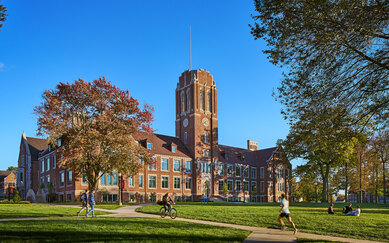
The Smith Hall of Science and Technology not only preserves the historic Hall of Science structure, it creates a cohesive science-focused hub integral to advancing the college’s STEM programs.
The project thoroughly upgrades the interior spaces and mechanical systems of the 1931 building, and physically joins it to STEM Hall with an architecturally cohesive three-story expansion. Designed for modern learning, research and experimentation, the new Smith Hall retains its iconic presence on the campus quad and reinforces Grove City College’s commitment to science education.
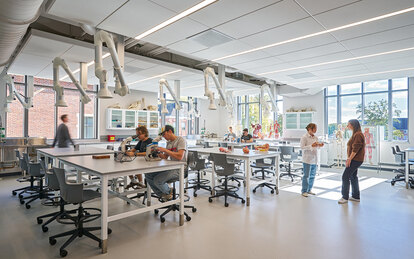
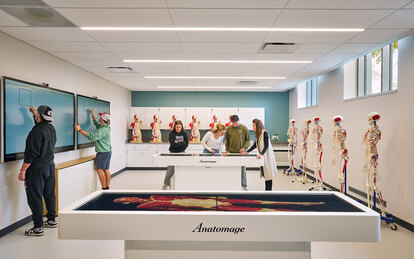
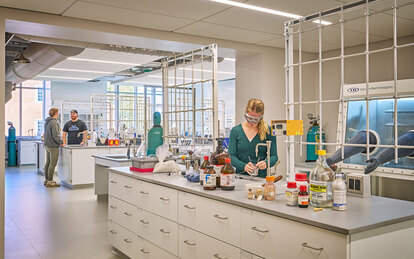
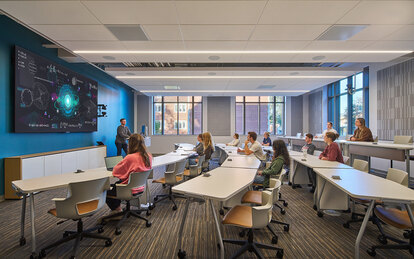
The design preserves the exterior brick façade and clocktower of Rockwell Hall, while completely reimagining all four levels of the interior, replacing small classrooms and cramped offices with large active learning spaces, laboratories, and collaboration areas. Entry to the building is on the first floor, which features vibrant public spaces and light filled classrooms. These spaces are open to the entire college and support cross discipline collaboration and STEAM. The ground floor and first floor house programs for robotics, fluid dynamics, and exercise science, including a virtual anatomy lab and environmental chamber for performing tests at different atmospheric pressures. Upper floors include labs for engineering, chemistry, physics, with student project labs adjacent to core teaching labs, and dedicated instrumentation rooms for research.
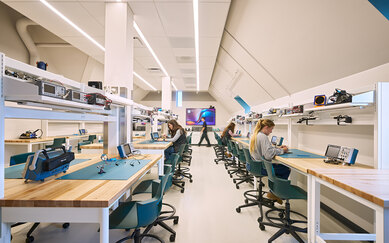
New mechanical systems throughout the building provide the necessary power and environmental controls to support advanced experimentation. Previously obscured windows were reopened to bring natural light into labs wherever possible.
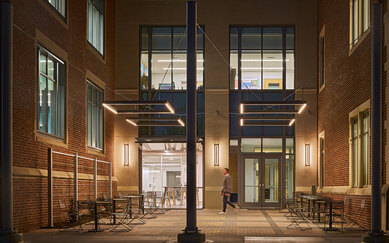
The three-story connector that links Smith Hall with the STEM Building successfully integrates Grove City’s Collegiate Gothic vernacular, blurring the distinction between old and new.
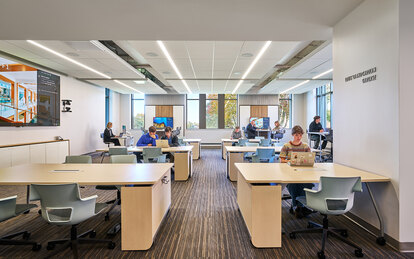
It adds 15,000 gsf of new space, dedicated to student study and collaboration zones, highly visible project studios, and experimentation labs that can spill out onto an outdoor science courtyard. This versatile, indoor/outdoor connector space is well-suited to host interdisciplinary studies, student competitions and special events.
By connecting its two science-focused academic buildings, this project enables Grove City College to foster greater connections among its academic programs and build deeper connections among students, faculty, teaching, and research. The integrated spaces reflect the collaborative, interdisciplinary nature of professional STEM environments, providing students with relevant, real-world skills for a successful STEM career.