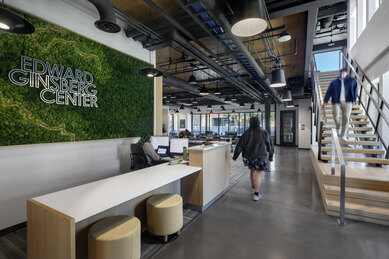
University of Michigan, Edward and Rosalie Ginsberg Building
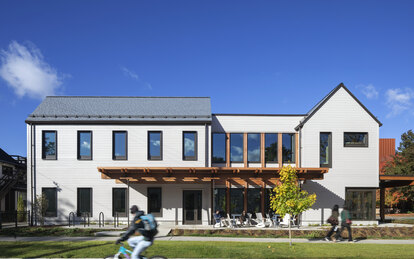
A deeply impactful center celebrates its new home, a modest building with lofty ambitions to affirm the interconnectedness of inclusivity, sustainability and community.
Client
University of Michigan
Location
Ann Arbor, Michigan
Markets/Services
Architecture, Higher Education, Sustainable Design, MEP Engineering
A New Home Where Campus Meets Community
The Edward and Rosalie Ginsberg Building supports and guides civic engagement among students, community organizations and the University of Michigan, building relationships that develop leaders and advance meaningful social change. The center’s supporters and the university sought to replace its insufficient 7,500-square-foot facility—a literal repurposed home—with a larger, universally accessible, climate-conscious building on the same campus site that provides more effective space for its outreach and better reflects its mission.
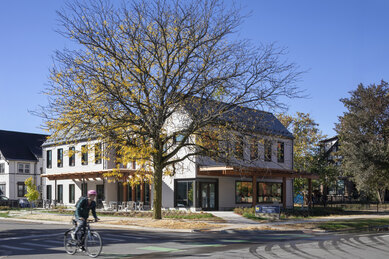
The 11,000-square-foot building embodies the phrase, “Where Campus Meets Community.” The design is driven by the center’s values and its location, that is, in fact, along the edge of campus and a residential neighborhood. It embraces climate justice with its high-performance design and systems, as one of U-M’s first all-electric, carbon-neutral buildings.
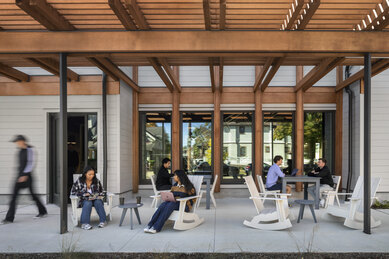
The building is composed of three residential-scale volumes with gabled roofs, small operable windows, and warm, conversation-focused street-side porches. This arrangement fosters an inviting, inclusive character respectful of the neighborhood, while also creating a new dynamic academic and social hub.
Hub for Collaboration, Community and Innovative Workspaces
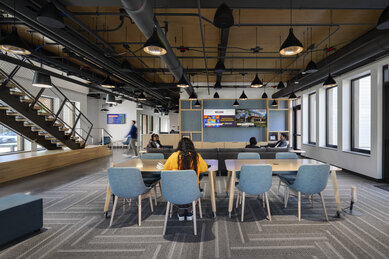
The new Edward and Rosalie Ginsberg Building enables greater engagement among students, faculty and community partners. The entire ground floor serves as a nexus for informal and planned engagements anchored by the Rosalie Ginsberg Community Commons that can accommodate large gatherings and flex to host a robust menu of presentations, seminars, workshops and other events. More intimate spaces, porch seating, and even a community garden provide welcoming venues for smaller groups and impromptu conversations.
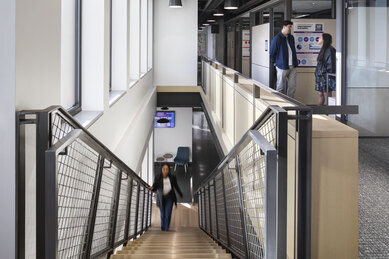
The second level, with abundant natural light and views of the yard and campus, comprises a range of flexible, team-based workspaces for staff and partners, as well as a resource library overlooking East University Avenue. Teams can cluster or spread out, with a choice of work environments including two- and four-person huddle rooms, touchdown areas, individual booths and a variety of acoustic settings to accommodate neurodivergent workstyles.
Advancing Community Wellbeing Through Sustainable Design
The building is a model of sustainable performance, on track to achieve LEED Gold certification, inspiring greater commitment to climate-conscious design. Energy consumption was reduced by 50% over a baseline through the use of 500-foot-deep underground vertical wells as an on-site closed-loop geothermal exchange system paired with water-source heat pumps for efficient electric heating and cooling. A dedicated ventilation system preconditions outdoor air with energy exchanged from the building’s exhaust air. A high-performance exterior envelope features triple-glazed windows and insulation values 50 percent greater than required by code. Hybrid timber construction using cross-laminated timber (CLT) and low-carbon concrete reduces the building’s embodied carbon footprint by 23%. Healthy, non-toxic materials were used with enhanced ventilation and filtration to ensure exceptional indoor air quality for occupants. Low-flow fixtures, native, drought-tolerant landscaping reduce water consumption. Bioretention basins retain a 90th-percentile storm on-site to improve water quality and increase flood resilience.
Underpinning the many strategies deployed regarding energy performance and carbon is the recognition that responsibility toward the health and wellness of individuals and buildings is intrinsically linked to the social and human health of our communities. Many of the sustainable practices and inclusive workplace designs in the Edward and Rosalie Ginsberg Building reflect that relationship and set a benchmark for future building designs on campus, regardless of scale—yet another way the center is driving positive and exponential change for the greater good across its campus and all the communities within its reach.