Transform Campus Spaces Through Real-Time Data
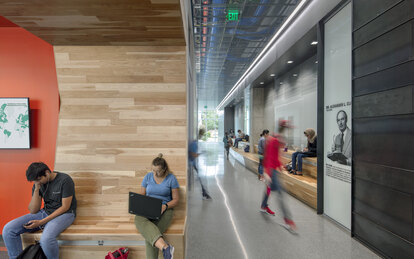
Discover how occupancy sensing technology drives space efficiency and optimizes utilization across your campus.
Key Takeaways:
- Occupancy sensing technology leverages sensors or Wi-Fi access points to detect the presence and movement of people, providing near real-time insights into how rooms and buildings are utilized.
- This technology is gaining traction in higher education, as institutions adopt it to better understand space needs and guide decisions on space policy and allocation.
- By delivering actionable data, occupancy sensing technology enables data-informed decisions that create campus environments that are more efficient, adaptable, and student-focused.
- Occupancy sensing technology provides a useful data point, but there are other data points that should be considered when studying space utilization and optimization.
Occupancy sensing technology has been around for a while, but it is becoming increasingly popular across higher education as more institutions are employing the technology to provide greater context for space needs and inform decision making for space policy and allocation.
What is Occupancy Sensing?
Occupancy sensing technology uses either sensors or Wi-Fi access points to detect the presence and movement of people in a space. The technology gathers near real-time data on how rooms and buildings are used. In higher education, the information gathered can be leveraged in a variety of ways, contributing to discussions of space utilization and needs, energy efficiency, safety and security.
Occupancy Sensing is Just One Tool in the Toolbox
It’s critical to understand that occupancy sensing is one of many useful data sets. Increasingly, colleges and universities are asking for occupancy sensing data as a part of space utilization studies to gain a more holistic understanding of space use on campus. Depending on the type of space studied, occupancy data can be paired with other data to paint a holistic picture of utilization.
Badge swipe data can be analyzed across administrative offices, libraries, and student life spaces to enable meaningful comparisons. Similarly, course scheduling data can be integrated with occupancy metrics to reveal how classrooms, teaching laboratories, and study areas are utilized, as well as the extent of in-person learning occurring in scheduled spaces.
A holistic look at occupancy and planned use can help improve scheduling, ensuring that existing spaces are more closely aligned with needs, and may ultimately reduce the need for unnecessary new construction. For example, if the occupancy sensing data indicates that specific classrooms are consistently under-occupied, institutions can reassign or redesign them to better align with demand and usage.
Benefits of Occupancy Data
- Optimize Energy Use: Integrate occupancy data with HVAC and lighting systems to reduce energy consumption in empty rooms, supporting sustainability goals and lowering operational costs.
- Align Security Coverage: Analyze occupancy patterns over time to help campus security match coverage to actual building use, complementing electronic access data.
- Reveal Actual Classroom Utilization: Pair course scheduling data with occupancy insights to understand how classrooms and labs are truly used, such as the proportion of students attending in person versus total enrollment, critical for planning hybrid learning options.
- Track Unscheduled Space Usage: Use occupancy sensing to measure utilization of open labs, collaboration areas, dining facilities, and fitness centers for better resource planning.
- Identify Informal Space Demand: Compare occupancy and course scheduling data to uncover informal use of spaces, highlighting unmet demand for collaboration areas often lacking on campuses.
Limitations of Occupancy Sensing
Occupancy sensing has limitations: indirect signals like motion or device presence can misrepresent actual occupancy, and defining what capacity means (design vs. safety capacities) complicates benchmarking. Privacy concerns are common, as perceptions of surveillance raise ethical and legal questions despite most systems avoiding PII data collection. Transparent communication before implementation helps mitigate these issues.
Conclusion
Occupancy sensing provides valuable data to inform strategic decisions that make campus environments more efficient, responsive, and student-centered. When analyzed meaningfully and combined with utilization and space needs data, it offers deep insights into space management and supports a wide range of applications—from building design to maintenance and operations. While using occupancy data in isolation has limitations, integrating it into a comprehensive space use study makes it a powerful tool for shaping space strategy and policy.